
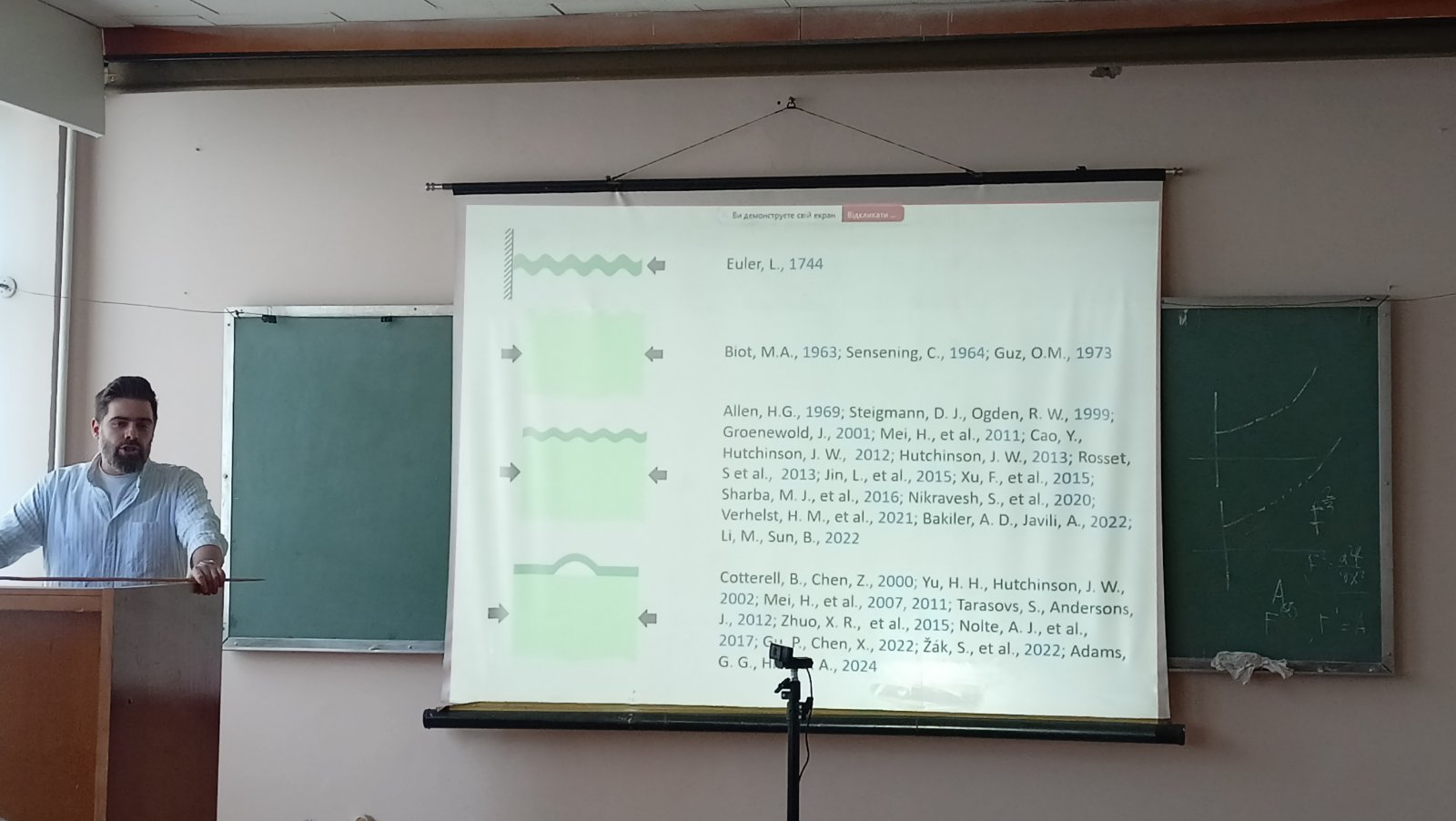
On 27 May 2026, the S.P. Timoshenko Institute of Mechanics of the NAS of Ukraine hosted Section 2, “Mechanics of Deformable Solids and Structures,” within the International Scientific Conference “Actual Problems of Mechanics and Mechanical Engineering – 2026,” organized by the G.S. Pisarenko Institute for Problems of Strength of the NAS of Ukraine.
The section programme covered six research areas and included more than 50 oral presentations delivered by researchers from academic institutions, universities, and research centres in Ukraine and abroad.
Fracture and fatigue mechanics
This research area included 14 presentations devoted to crack mechanics, fatigue fracture, creep, material damage, and modern methods for assessing the durability of structures.
Contact mechanics
Participants presented 8 reports on contact interaction of bodies, thermomechanical contact problems, the effects of friction and wear, and studies of metamaterials.
Theory of vibrations
This area brought together 7 presentations on vibrations of plates and shells, wave processes in elastic media, and the dynamics of engineering structures.
Mechanics of coupled fields
Eight presentations were delivered on thermomechanics, electroelasticity, micropolar media, and problems involving the interaction of mechanical, thermal, and electromagnetic fields.
Mechanics of composite and inhomogeneous media
This research area included 6 presentations on functionally graded materials, composite structures, metamaterials, additive technologies, and the use of physics-informed neural networks.
Mechanics of shell systems
The final research area included 7 presentations devoted to the stress-strain state of shells and plates, stability problems, creep, and the dynamic behaviour of thin-walled structures.
Two poster presentations were also presented, focusing on the assessment of the technical condition of aircraft and the loss of load-bearing capacity of structures under combat damage.
Holding the section at the Institute of Mechanics provided an important platform for discussing recent advances in the mechanics of deformable solids, developing scientific cooperation, and exchanging research results among scientific teams.