
The beginning of a scientific path
The formation of S.P. Timoshenko as a scientist in mechanics and educator
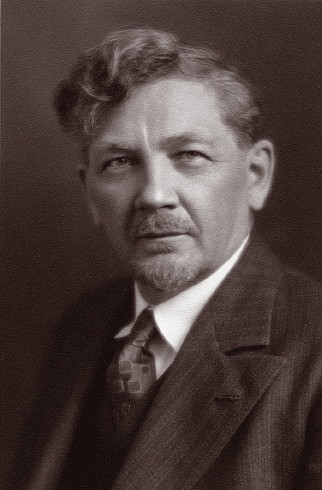
Stepan Prokopovych Timoshenko (1878–1972) was an outstanding scientist in mechanics of worldwide renown, a prominent organiser of science and a distinguished educator. Professor S.P. Timoshenko entered the history of Ukrainian science as one of the founders of the Ukrainian Academy of Sciences, now the National Academy of Sciences of Ukraine, and as the founder and first director of the Institute of Mechanics of the NAS of Ukraine, which now bears his name.
Stepan Prokopovych Timoshenko was born on 23 December 1878 in the village of Shpotivka, Konotop county, Chernihiv province, now Sumy region, into the family of the land surveyor Prokip Tymofiiovych Timoshenko and his wife Yuzefina Yakivna Sarnavska, the daughter of a retired Polish military officer.
In 1896 he graduated from a vocational school in the town of Romny and entered the Institute of Railway Engineers in St Petersburg. This was a prestigious technical educational institution, founded in 1809, where mathematics, mechanics and thermodynamics were taught by such well-known professors as D.O. Grave, D.I. Zhuravsky, M.A. Belelyubsky, O.M. Krylov and O.A. Brandt. After graduating in 1901, he worked at this institute until 1906, as well as at the St Petersburg Polytechnic Institute, studying, in particular, resonance phenomena in shafts, the stability of the plane form of beam bending, buckling of rods in elastic media, and stress concentration in joints. During this period he undertook a scientific visit to France in 1901 and, in 1904–1906, attended lectures and trained in Germany at the universities of Munich and Göttingen under the renowned scientists in mechanics A. Föppl (1854–1924) and L. Prandtl (1875–1953).
While working at the St Petersburg Polytechnic Institute, S.P. Timoshenko became acquainted with Viktor Lvovych Kirpichov (1845–1913), a well-known specialist in strength of materials and the founder of engineering schools at the Kharkiv Technological Institute and the Kyiv Polytechnic Institute. According to Timoshenko himself, Kirpichov had a decisive influence on his scientific and teaching career. It was Kirpichov, the first rector of the Kyiv Polytechnic Institute in 1898–1902, who advised the young scientist to compete for the vacant professorship at the Kyiv Polytechnic Institute. Having been elected to this position, S.P. Timoshenko moved to Kyiv in 1906. The following year he defended his dissertation and received the academic degree of adjunct in applied mechanics. Soon he became head of the Department of Strength of Materials, and in 1908 secretary and later dean of the mechanical and civil engineering faculties (1909–1911). However, after signing a protest in January 1911 against police arbitrariness, he was dismissed together with other professors.
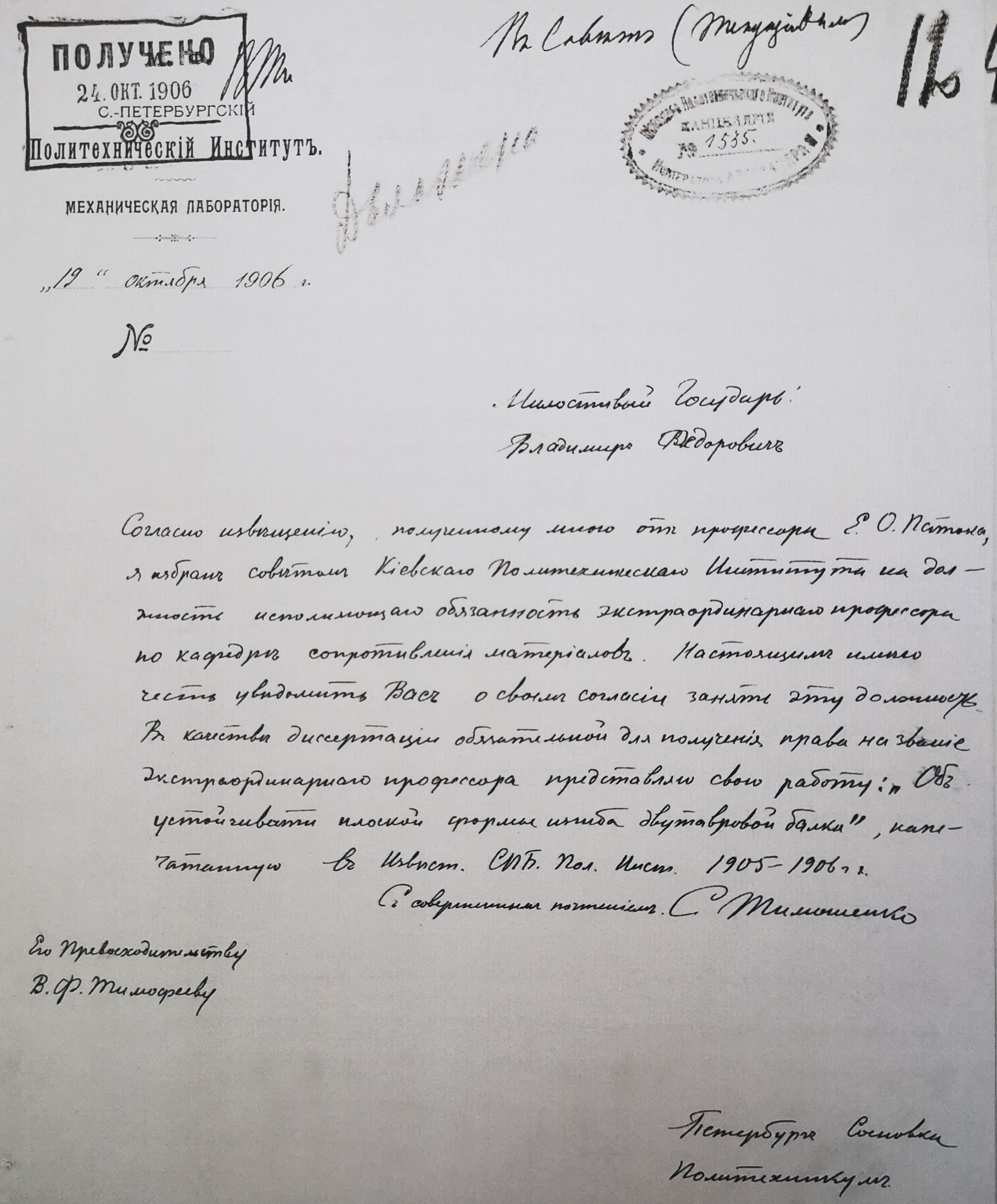
This relatively short first period of work at the Kyiv Polytechnic nevertheless proved very fruitful for the scientist. He completely changed the teaching of strength of materials and the theory of elasticity and prepared fundamental textbooks on the theory of vibrations, the theory of stability of deformable systems, engineering mechanics, applied dynamics, and the theory of plates and shells. Timoshenko studied the stability of plates, circular rings and compressed slabs, the influence of circular holes on the stress distribution in plates, and forced vibrations of prismatic rods. One result of his scientific work was the monograph On the Stability of Elastic Systems, published in 1910 and awarded the D.I. Zhuravsky Prize “for outstanding works in structural mechanics”; problems of stability of elastic systems were also considered in his German-language paper.
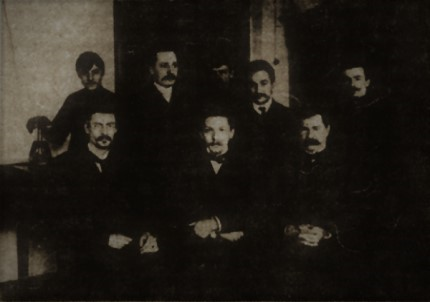
After his dismissal from the Kyiv Polytechnic Institute, Stepan Prokopovych returned to St Petersburg, where he later held professorial positions at the Polytechnic Institute, the Electrotechnical Institute and the Institute of Railway Engineers. He was also involved as a scientific consultant in the construction of warships and undertook a scientific visit to Great Britain.
During these years he carried out research on the strength of steam turbines, deformation and stability of cylindrical and spherical shells, bending and torsion of prismatic rods, vibration and dynamic stresses in railway rails, and impact loads on beams. He published a number of recognised scientific works, including abroad, and created the textbooks Course of Strength of Materials (1911) and Course of the Theory of Elasticity (1914–1916), which became classics and were repeatedly republished and translated into English. His teaching experience inspired him to develop the idea of a new model of technical education. Together with other scientists, he prepared a curriculum and a project for the creation of an engineering and research physics-mechanics faculty within the St Petersburg Polytechnic Institute, an institution that at that time had no analogue in the world.
Ukrainian Academy of Sciences
S.P. Timoshenko’s role in organising the Ukrainian Academy of Sciences and the Institute of Technical Mechanics
Thus, when he returned to Kyiv at the end of 1917, after the Bolshevik coup in Petrograd, at the invitation of the council of professors of the Kyiv Polytechnic Institute to take up a professorship there, S.P. Timoshenko already had a reputation not only as a well-known scientist in mechanics and educator, but also as an expert on the organisation of scientific research in mechanics in the leading countries of Western Europe.
These factors were evidently decisive for Mykola Prokopovych Vasylenko (1866–1935), Minister of Public Education and Arts in the Hetman government of P. Skoropadskyi and a scholar of law, and for Volodymyr Ivanovych Vernadsky (1863–1945), the renowned geologist and geochemist, member of the Russian Academy of Sciences, who in early summer 1918 invited Professor Timoshenko to work in the Commission for the Organisation of the Ukrainian Academy of Sciences.
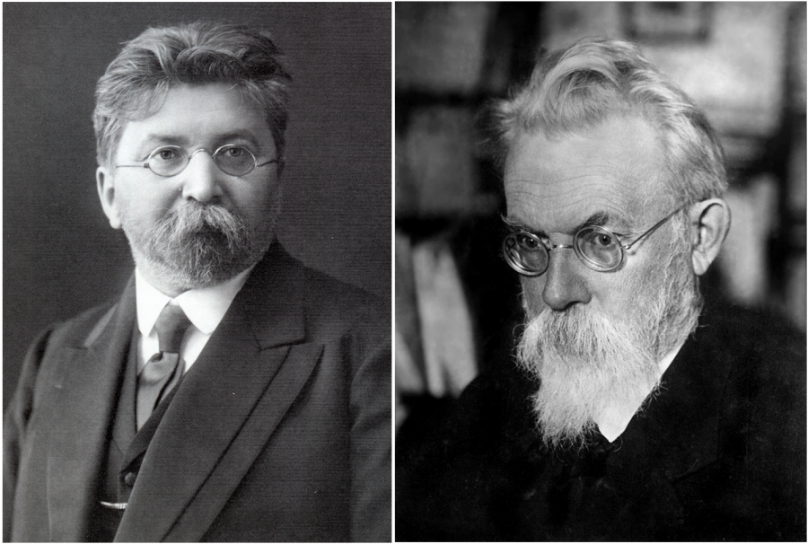
According to Academician Vernadsky’s concept, the Academy was to become the country’s main scientific centre, uniting research institutions across a broad range of technical, natural, social and human sciences. Vernadsky was convinced that only a state-based concept of Academy development would make it possible to form a strong scientific base and national scientific personnel. His ideas were grounded in a vision of future social, economic and technological progress and, accordingly, of the growing role of science as a productive force in developing the foundations of the state and its economic strength. Alongside the fundamental fields of the natural sciences, Vernadsky placed a “division of applied natural science”, where knowledge related to technology, industry, agriculture, forestry and water management was to be developed.
Stepan Prokopovych was among the few representatives of the natural and technical fields in the Commission who laid the foundations of the future Academy, developed the conceptual basis for its natural-science and technical directions, and stood at the head of the first academic institutes and departments. The Commission worked from July to October 1918.
On 22 July, S.P. Timoshenko delivered a keynote report on the organisation of applied natural science within the Ukrainian Academy of Sciences. In it he noted, in particular, that “the times when science and technology followed separate paths have already passed; and today, very often, to solve purely technical problems, one uses the powerful instrument provided by mathematics and mechanics”. Timoshenko proposed organising, within the Second, Physico-Mathematical Department, a class of applied natural science, thereby bringing together science and technology to fulfil the main tasks of developing science in Ukraine, studying the natural resources of the country, and developing and improving methods for their use.
In the same report, Stepan Prokopovych pointed to the important role of the Academy in training professional personnel and professors for higher education in the technical sciences. He stated that the question of training professors had long been placed on the agenda by life itself: universities and higher technical schools constantly felt a shortage of properly trained professors, and many departments remained vacant from year to year. In Ukraine this issue would become even more urgent, since a number of new higher schools were planned, while no ready professors were available for them. It was therefore natural, in his view, to entrust the training of future professors to the Academy of Sciences.
At the Commission meeting on 24 July, he reported on the expediency of granting the Academy the right to train highly qualified scientific personnel and award academic degrees, including the right to confer the degree of Doctor of Sciences for outstanding scientific work, a prerogative previously held by universities. This would allow the Academy to replenish its own ranks with specialists in fundamental and applied sciences.
Timoshenko also considered the possibility of creating applied chairs within the Physico-Mathematical Department, including a chair of technical mechanics with laboratories of applied mechanics and structural mechanics. These could bring together such subjects as kinematics and dynamics of machines, steamships, railway engineering and aviation, hydraulics and hydrodynamics with applications, aerodynamics, the theory of elasticity, strength of materials, structural statics as applied to the calculation of bridges, roofs, vaults and beams, as well as problems of the strength of ships and aeroplanes. The laboratory base was to be united in the Institute of Technical Mechanics, where departments of applied mechanics and structural mechanics were to be opened.
On 4 September, the Commission discussed proposals to include in the Academy’s Statute a prospective list of scientific institutions, in particular an Astronomical Laboratory, a Botanical Garden, a Geodetic Institute, a Geological Committee and the Institute of Technical Mechanics.
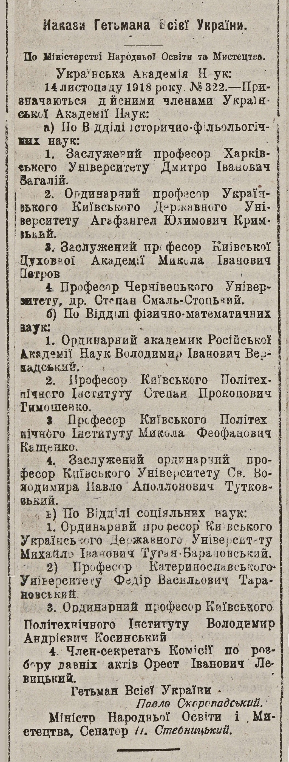
The work of the Commission ended with the adoption, on 14 November 1918, of the Law of the Ukrainian State on the establishment of the Ukrainian Academy of Sciences in Kyiv, signed by Hetman of All Ukraine Pavlo Skoropadskyi. On the same day, by order of the Hetman, the first twelve full members of the Academy were appointed; among them was the youngest academician, the 39-year-old S.P. Timoshenko.
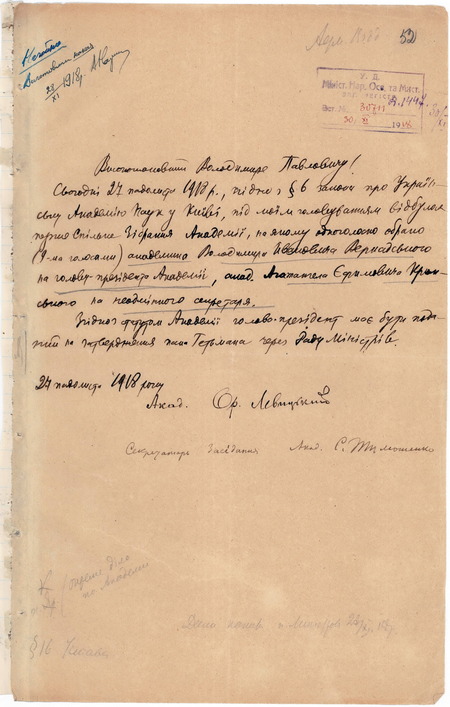
On 27 November 1918, the beginning of the full functioning of the Academy was marked by its first constitutive General Assembly. At the meeting, chaired by the oldest academician, O.I. Levytskyi, and with the youngest academician, S.P. Timoshenko, serving as secretary, Academician V.I. Vernadsky was unanimously elected President-Chairman, and Academician A.Yu. Krymskyi Permanent Secretary. That same day, Academicians O.I. Levytskyi and S.P. Timoshenko informed Minister of Public Education of the Ukrainian State V.P. Naumenko by letter of the election of the President-Chairman and Permanent Secretary; on 30 November 1918, the Hetman issued an order appointing Academician V.I. Vernadsky President-Chairman of the UAS. The General Assembly elected M.T. Kashchenko as head of the Physico-Mathematical Department, while S.P. Timoshenko became secretary of the Department, a position he conscientiously held until his departure abroad in early 1920.
Thanks to the organisational energy and personal qualities of Academician S.P. Timoshenko, the Institute of Technical Mechanics was created as one of the first institutes of the Academy. This happened on 30 November 1918 at the second General Assembly of the UAS, where Stepan Prokopovych was approved as director of the Institute. At the same meeting, Academician Timoshenko was elected head of the Chair of Applied Mechanics and head of the Section of Construction Materials.
The first years of the Institute
Scientific and organisational activity of S.P. Timoshenko in the Academy
The Academy’s report for 1919 noted S.P. Timoshenko’s major scientific and organisational contribution, including the creation of institutes, chairs and laboratories, the development of publishing activity for scientific works, and the search for premises, materials and funds for acquiring laboratory equipment.
Under his leadership, from the beginning of 1919 a scientific seminar on theoretical questions of a technical nature began its work, and the publication Proceedings of the Institute of Technical Mechanics was launched. Important studies were conducted by S.P. Timoshenko and E.K. Garf on the strength of reinforced concrete beams under variable loads and on the strength of a spherical film under uniform pressure. At that time Stepan Prokopovych wrote his works On the Strength of Aeroplanes and Calculation of Arches.
Developing the idea of integrating science and technology, Academician S.P. Timoshenko, as director of the Institute of Technical Mechanics, initiated and chaired the Council on Construction Materials. Its responsibilities included approving standards for various construction materials, programmes of relevant research work, reports of the testing station and related tasks.
Timoshenko proposed that the Council include two heads of departments of the testing station, the director of the Institute of Applied Physics, the director of the Geological Committee, an academician from the chair of geology, two academicians elected by the Second Department, representatives of the ministries of transport, trade and industry, land affairs, the military and naval ministries, and three representatives from the Kyiv Polytechnic, Kharkiv Technological and Katerynoslav Mining Institutes.
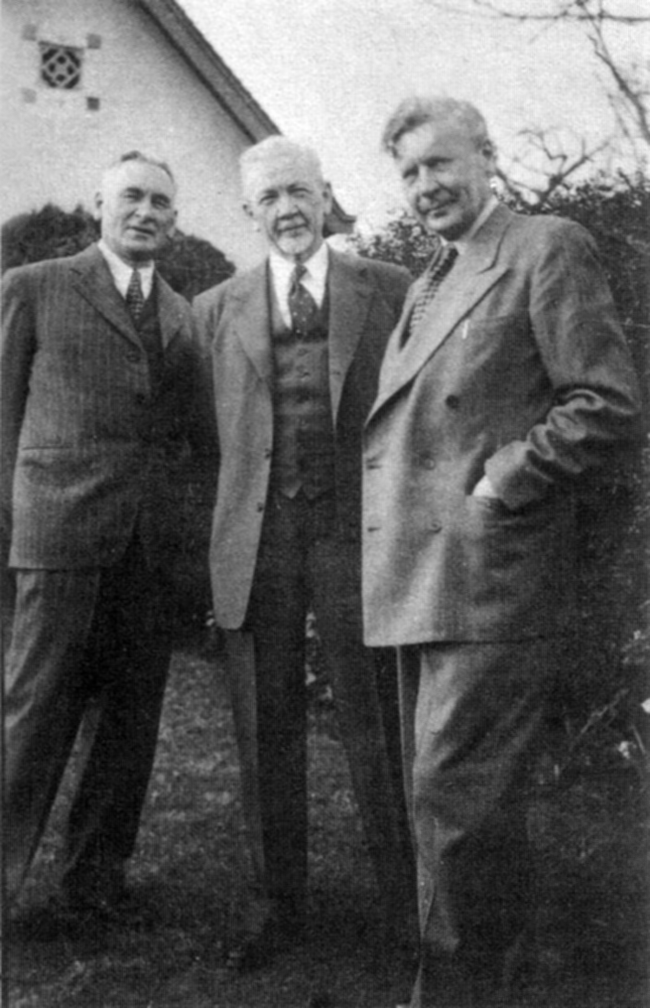
Summing up the selfless work of Academician S.P. Timoshenko in the Ukrainian Academy of Sciences, it should be noted that Stepan Prokopovych was one of V.I. Vernadsky’s like-minded colleagues and together with him laid the foundations for the Academy’s future achievements. With his active participation, the Physico-Mathematical Department acquired priority importance, while he himself became head of the Academy’s first research institution — the Institute of Technical Mechanics — and created the prerequisites for its further effective activity. Thus, S.P. Timoshenko can rightly be regarded as the founder of the development of research in mechanics at the National Academy of Sciences of Ukraine.
It is also worth noting that during the years of the Ukrainian Revolution of 1917–1920, Stepan Prokopovych’s brothers — Serhii Prokopovych, an architect by profession, and Volodymyr Prokopovych, an economist by profession — were prominent public and political figures and statesmen of the Ukrainian People’s Republic and actively participated in the development of Ukrainian statehood.
A worldwide scientific school
Life and work of S.P. Timoshenko in emigration
Due to the political and economic situation that arose after the arrival in Kyiv first of Denikin’s forces and then of the Bolsheviks, the activity of the UAS was effectively suspended. This forced S.P. Timoshenko in March 1920 to decide to leave the country.
At first he headed the Department of Strength of Materials at the Zagreb Polytechnic Institute, and in 1922 accepted an invitation to move to the United States. For his first five years there he worked in Philadelphia in the research department of the Westinghouse company, where, among other things, he organised evening seminars to improve the qualifications of engineers in technical mechanics. In 1927 he moved to academic teaching.
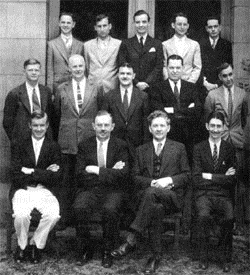
He became head of the Department of Applied Mechanics at the University of Michigan, where in 1929 he opened a summer school in mechanics for graduate specialists, which was of great significance for the development of this science and for the training of specialists in the United States. There he gave special lecture courses through which hundreds of engineers deepened their knowledge. Under his supervision about forty doctoral dissertations were defended. At that time Professor S.P. Timoshenko also organised a mechanics section within the American Society of Mechanical Engineers.
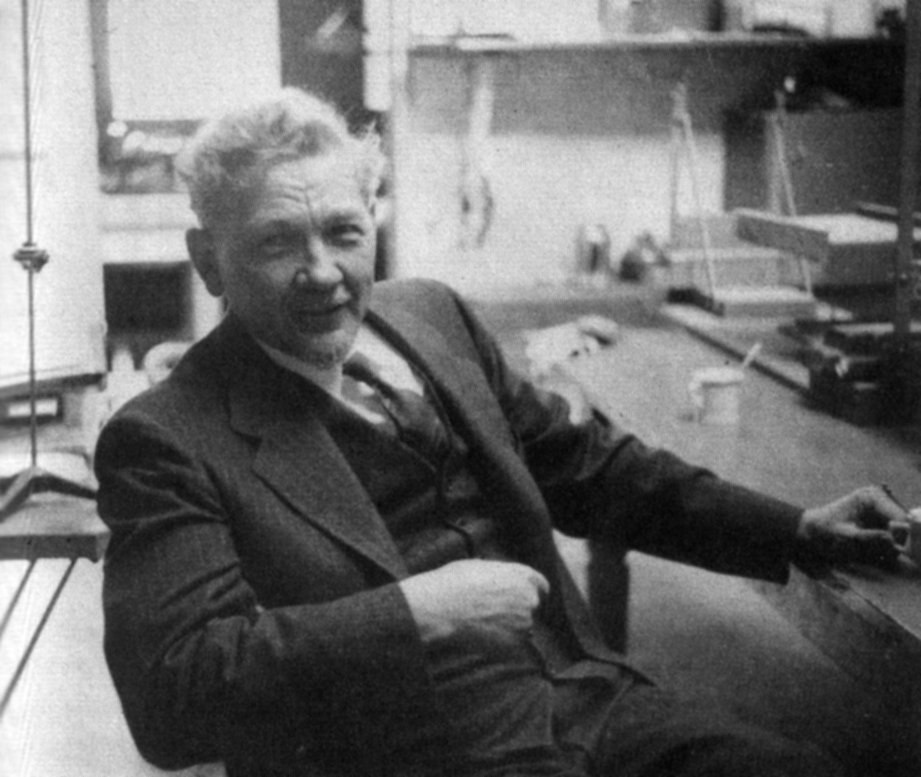
From 1936, for a quarter of a century, the scientist taught at Stanford University: until 1943 he was head of the Department of Mechanics and then, until 1960, its professor. There he developed bachelor’s and doctoral programmes in engineering mechanics.
Stepan Prokopovych devoted more than sixty years to the development of engineering science and education in different countries. In the final years of his scientific and teaching activity, he travelled extensively, visiting universities and scientific laboratories in Germany, Great Britain, France, Italy, Switzerland and other Western European countries, giving lectures and reports, and collecting materials for his well-known book on the history of strength of materials. Having retired in 1960, from 1964 he lived with his daughter Hanna in Wuppertal, Germany. S.P. Timoshenko died on 29 May 1972 and was buried next to his wife in Palo Alto, USA.
Thanks to his scientific and engineering talent and exceptional capacity for work, S.P. Timoshenko made an enormous contribution to world science. His scientific works became the basis for the development of numerous areas of mechanics. For many years he held a leading position among specialists in mechanics in the United States.
In a letter to V.I. Vernadsky written as early as 1923, Stepan Prokopovych emphasised the almost unlimited opportunities that were opening in the United States for research in mechanics, oriented primarily toward applied use. This enabled the scientist to realise his research ideas. It is no coincidence that, opening the Twelfth International Congress of Applied Mechanics held in August 1968 at Stanford University, Congress President Professor N.J. Hoff noted that S.P. Timoshenko had done very much for the development of applied mechanics, particularly in the United States of America.
His contribution was especially great in the development of applied theory of elasticity, the theory of stability of shell and plate systems, including those reinforced by stiffeners. Important studies by S.P. Timoshenko concerned bending, torsion, vibration and impact of structural elements. He solved a number of problems related to stress concentration near holes and the strength of railway rails under dynamic loads. In the theory of thin-walled systems, the so-called Timoshenko-type model, which takes shear deformations into account, became widely used.
Professor Timoshenko studied deeply the history of the science of strength of materials and made a major contribution to the formation of engineering education. He created a series of unique monographs and textbooks in various fields of engineering mechanics, translated into many languages and used to educate many generations of specialists in mechanics.
Commemoration
Honouring the memory of the outstanding scientist in Ukraine and worldwide
Stepan Prokopovych Timoshenko visited Ukraine twice, in 1958 and 1967, and visited scientific institutions and higher educational establishments in Kyiv, Lviv and Kharkiv. During his last trip, he also visited the town of Romny in Sumy region, where he had received his primary education. Recalling his 1958 visit to the Institute of Mechanics, which he had founded, he wrote: “The inspection of the mechanics laboratory gave me great satisfaction. The main idea of bringing science and technology closer together, which had so inspired me when organising the Chair of Mechanics at the Kyiv Academy of Sciences, proved viable, and the laboratory I had planned is actively participating in solving important technical problems of the country.”
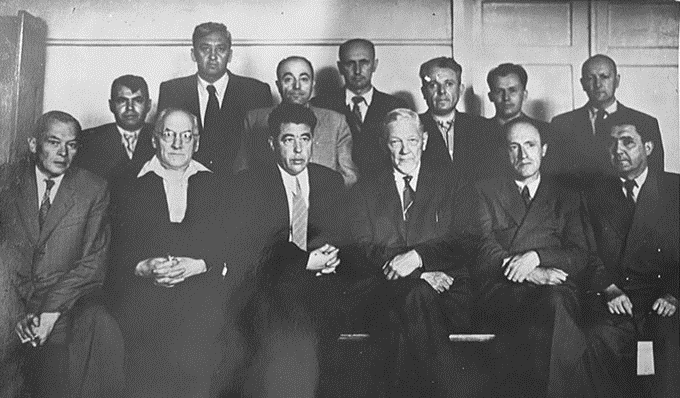
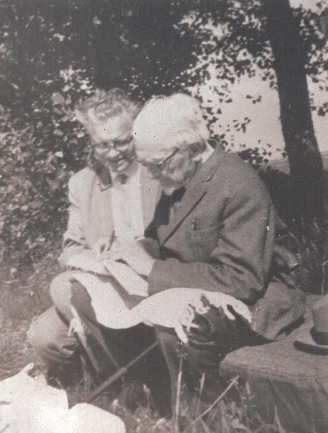
The outstanding scientific achievements of S.P. Timoshenko were recognised throughout the world. He was elected a member of the Ukrainian (1918), Polish (1935), French (1939) and Italian (1948) academies of sciences, the Academy of Sciences of the USSR (1928), and the Royal Society of London (1944). He was also a full member of the Shevchenko Scientific Society (1924) and an honorary doctor of many universities.
In 1957, the American Society of Mechanical Engineers established the S.P. Timoshenko Medal, which he was the first to receive “for his inestimable contributions and personal example as leader of a new era in applied mechanics”.
The outstanding contribution of Academician S.P. Timoshenko to Ukrainian and world science has also been honoured in Ukraine. In 1993, his name was given to the Institute of Mechanics of the NAS of Ukraine, and in 1999 the Academy established the S.P. Timoshenko Prize for outstanding achievements in theoretical and applied mechanics. In 1998, a monument to Stepan Prokopovych was erected on the grounds of the Kyiv Polytechnic Institute. A memorial plaque was also installed on building No. 23 on Hoholivska Street in Kyiv, where he lived in 1917–1920.
Stepan Prokopovych Timoshenko belongs to the cohort of outstanding sons of the Ukrainian people who, through their talent and tireless creative work, glorified Ukrainian science and Ukraine throughout the world. His unsurpassed achievements in scientific, organisational and pedagogical work continue, and will continue, to serve as a vivid example for new generations of researchers.
Bibliography
Selected publications by S.P. Timoshenko
- Тимошенко С.П. К вопросу о явлениях резонанса в валах // Известия С.-Петербургского политехнического института. – 1905. – Т. 3, вып. 1–2. – С. 55–106.
- Тимошенко С.П. Формулы сложного сопротивления с точки зрения различных теорий о прочности // Известия С.-Петербургского политехнического института. – 1905. – Вып. 3–4. – С. 415–455.
- Тимошенко С.П. Об устойчивости плоской формы изгиба двутавровой балки под влиянием сил, действующих в плоскости ее наибольшей жесткости. – Санкт-Петербург: Тип. Шредера, 1906. – 130 с.
- Тимошенко С.П. К вопросу о дополнительных напряжениях, обусловленных жесткостью узлов // Известия С.-Петербургского политехнического института. – 1907. – Т. 7, вып. 1. – С. 35–144.
- Тимошенко С.П. О продольном изгибе стержней в упругой среде // Известия С.-Петербургского политехнического института. Отдел техники, естествознания и математики. – 1907. – Т. 7, вып. 1. – С. 145–157.
- Тимошенко С.П. К вопросу об устойчивости сжатых пластинок // Известия Киевского политехнического института. – 1907. – Год 7. – Кн. 2. – С. 35–94.
- Тимошенко С.П. О влиянии круглых отверстий на распределение напряжений в пластинках // Известия Киевского политехнического института. – 1907. – Вып. 3. – С. 95–113.
- Тимошенко С.П. К вопросу о продольном изгибе // Известия Киевского политехнического института. – 1908. – Год 8. – Кн. 2. – С. 181–212.
- Тимошенко С.П. О распределении напряжений в круговом кольце, сжатом двумя взаимно противоположными силами. – Киев: Тип. Кульженко, 1908. – 17 с.
- Тимошенко С.П. Сопротивление материалов: Курс, читанный в Киевском политехническом институте в 1908 г. – Киев, 1908. – Ч. 1. – 389 с.
- Тимошенко С.П. Стабильность плит при сжатии. – Киев: Тип. Кульженко, 1908. – 60 с.
- Тимошенко С.П. О вынужденных колебаниях призматических стержней // Известия Киевского политехнического института им. Александра ІІ. – 1909. – Год 9. – Кн. 4. – С. 201–252.
- Тимошенко С.П. О вынужденных колебаниях призматических стержней: приложение к исследованию колебания мостов. – Киев: Тип. Кульженко, 1909. – 50 с.
- Тимошенко С.П. Курс теории упругости: Лекции, читанные в Киевском политехникуме 1908–1909 учебном году. – Киев: Тип. «Прогресс», 1909. – 238 с.
- Тимошенко С.П. Об устойчивости упругих систем: Применение новой методы к исследованию устойчивости некоторых мостовых конструкций. – Киев: Тип. Кульженко, 1910. – 188 с.
- Timoshenko S.P. Einige Stabilitätsprobleme der Elastizitätstheorie // Zeitschrift für Mathematik und Physik. – 1910. – 58. – S. 337–385.
- Тимошенко С.П. Курс сопротивления материалов. – Киев: Изд-во кн. маг. Л. Идзиковского, 1911. – 519 с.
- Timoshenko S.P. Erzwungene Schwingungen prismatischer Stäbe // Zeitschrift für Mathematik und Physik. – 1911. – 59. – S. 163–203.
- Timoshenko S.P. Zur Frage nach der Wirkung eines Stosses auf einen Balken // Zeitschrift für Mathematik und Physik. – 1913. – 62. – S. 198–209.
- Timoshenko S.P. Etude de la flexion des barres au moyen d’une méthode approximative // Annales des Travaux de Belgique. 71 séries. – 1914. – 19. – S. 263–296.
- Тимошенко С.П. Курс теории упругости: Ч. 1–2. – Санкт-Петербург: Тип. Коллинса, 1914–1916. Ч. 1. – 1914. – 240 с.
- Тимошенко С.П. Курс теории упругости: Ч. 1–2. – Санкт-Петербург: Тип. Коллинса, 1914–1916. Ч. 2: Стержни и пластинки. – 1916. – 416 с.
- Timoshenko S.P. On the correction for shear of the differential equation for transverse vibrations of prismatic bars // Philosophical Magazine. – 1921. – May. – P. 744–746.
- Timoshenko S.P. Applied Elasticity. – East Pittsburg: Westinghouse Mechanical Night School Press, 1925.
- Timoshenko S.P. Strength of Materials. – Princeton: D. van Nostrand Company, 1930.
- Timoshenko S.P. Theory of Elasticity. – New York: McGraw-Hill Book Company Inc., 1933.
- Timoshenko S.P. Elements of Strength of Materials, Part I and II. – Princeton: D. van Nostrand Company, 1935.
- Timoshenko S.P. Theory of Elastic Stability. – New York: McGraw-Hill Book Company Inc., 1937.
- Timoshenko S.P. Theory of Plates and Shells. – New York: McGraw-Hill Book Company Inc., 1940.
- Timoshenko S.P. Theory of Structures. – New York: McGraw-Hill Book Company Inc., 1945.
- Timoshenko S.P. Advanced Dynamics. – New York: McGraw-Hill Book Company Inc., 1948.
- Timoshenko S.P. Theory of Elasticity. – New York: McGraw-Hill Book Company Inc., 1951.
- Timoshenko S.P. History of Strength of Materials. – New York: McGraw-Hill Book Company Inc., 1953. – 452 p.
- Timoshenko S.P. Collected Papers. – New York: McGraw-Hill Book Company Inc., 1954.
- Timoshenko S.P., Woinowsky-Krieger S. Theory of Plates and Shells. – New York: McGraw-Hill Book Company Inc., 1959.
- Timoshenko S.P. As I Remember (Autobiography). – Princeton: Van Nostrand Company, 1968. – 430 p.
- Тимошенко С. Воспоминания. – Киев: Наукова думка, 1993. – 424 с.
Sources
- Институт механики им. С.П. Тимошенко НАН Украины (1918–2008). – 90 лет Института (История. Структура. Информационные аспекты) / Под общ. ред. А.Н. Гузя (сост. И.С. Чернышенко, Я.Я. Рущицкий). – Киев: Літера ЛТД, 2008. – 320 с.
- Guz A.N., Altenbach H., Bogdanov V.L., Nazarenko V.M. Preface. In: Guz A.N., Altenbach H., Bogdanov V., Nazarenko V.M. (eds) Advances in Mechanics. Advanced Structured Materials, vol. 191. Cham: Springer, 2023. – P. v–xv.
- Богданов В.Л. Роль академіка С.П. Тимошенка у становленні і розвитку досліджень в галузі механіки в Україні // Прикладна механіка. – 2024. – 60, № 1. – С. 3–12.
This page is based on the article by Academician V.L. Bogdanov “S.P. Timoshenko — Founder of the Institute of Mechanics”.