
Shared-Use Centre for LMS SCADAS Mobile Portable Equipment
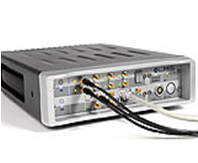
The Shared-Use Centre “Dynamic Process Analyser” was established at the S.P. Timoshenko Institute of Mechanics of the NAS of Ukraine on the basis of the Department of Dynamics and Stability of Continua. The centre is built around an LMS SCADAS Mobile portable 8-channel recorder of vibration, acoustic and strain-gauge signals manufactured by LMS International.
The measurement system includes an analyser in an SCM01 chassis, a laptop computer, and LMS Test.Xpress software.
The centre is a structural unit of Department 1 — the Department of Dynamics and Stability of Continua.
Centre Equipment
LMS SCADAS Mobile is a universal mobile analyser for the measurement and analysis of signals of quasi-static and dynamic processes. It is compatible with virtually any type of sensor, including strain gauges, accelerometers, microphones and other measuring devices.
The main capabilities of the analyser are:
- overall dynamic range — 178 dB;
- amplitude error — no worse than ±0.2%;
- maximum sampling rate — 204.8 kHz;
- real-time signal recording and visualisation;
- simultaneous calculations and spectral processing;
- quasi-static and dynamic strain measurement;
- fast Fourier transform for determining resonance frequencies;
- operation in laboratory and field conditions;
- analyser dimensions — 203 × 58 × 260 mm;
- weight — 2.5 kg;
- built-in battery providing up to 3 hours of autonomous operation.
Use at the Institute
At the S.P. Timoshenko Institute of Mechanics of the NAS of Ukraine, the analyser is used for experimental investigations of deformation processes in structural elements subjected to shock-wave loading.
Since the establishment of the Centre in 2010, experimental research has been carried out by qualified researchers of the Department of Dynamics and Stability of Continua: I.I. Anikiev, Candidate of Technical Sciences; V.A. Maksymiuk, Doctor of Physical and Mathematical Sciences; M.I. Mykhailova, Doctor of Technical Sciences; and Ye.O. Sushchenko, Candidate of Technical Sciences.
The first head of the Centre was I.I. Anikiev, Candidate of Technical Sciences. At present, the recorder is operated by V.A. Maksymiuk, Doctor of Physical and Mathematical Sciences.
Example of Strain Registration
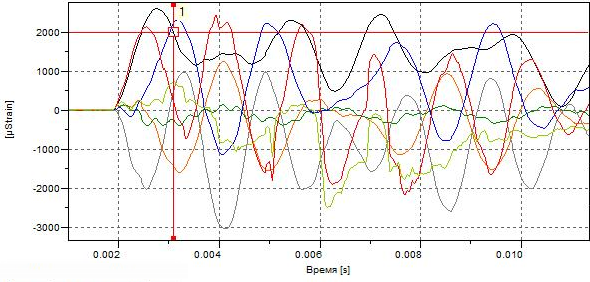
Figure 2 shows an example of the strain-registration result displayed on a personal computer screen for an elastically deformable statically indeterminate system consisting of a cantilever supported by a rod attached to it. The elements of the system were made of fiberglass.
The shock wave in air was generated in the channel of a diaphragm shock tube. One end of the cantilever, which received the shock-wave front, was rigidly attached to the end of the measuring section. During the tests, the strains of the cantilever and of the rod fixed to the middle of the free side of the cantilever were recorded.
On the oscillogram, the solid vertical and horizontal lines intersecting at the centre of the small square represent cursors. During processing and measurement, they make it possible to determine the strain values of each strain gauge with high precision at any selected instant of time.
The strain values may range from a few microstrains (10⁻⁶) to tens of thousands of microstrains, depending on the capabilities of the strain gauges used. The registration shown in Fig. 2 was performed over a time interval of approximately 0.01 s.
Quasi-Static and Vibration Processes
Along with very fast transient processes, the LMS SCADAS Mobile analyser also makes it possible to record quasi-static and vibration processes, which substantially broadens the range of experimental studies that can be performed at the Centre.
The equipment can be used to analyse the stress-strain state of structural elements under long-duration loading, to identify natural frequencies and vibration modes, and to evaluate the dynamic response of engineering objects under laboratory and field conditions.
Use of the Centre
In accordance with the standard regulations approved by the Presidium of the NAS of Ukraine, part of the Centre’s working time is allocated for the free provision of services based on planned requests from research institutions of the NAS of Ukraine, higher education institutions, and other publicly funded organisations.
To include a task in the Centre’s work plan, a user may submit a request to the Bureau of the Department of Mechanics of the NAS of Ukraine or directly to the Centre, specifying the required number of hours, time frame, and type of research for which the LMS SCADAS Mobile analyser is needed.
Management and Contacts
By order of the Director of the Institute of Mechanics of the NAS of Ukraine, the head of the Centre is V.A. Maksymiuk, Doctor of Physical and Mathematical Sciences.
Supervision of the Centre’s activities is exercised by the Deputy Director of the S.P. Timoshenko Institute of Mechanics of the NAS of Ukraine, Corresponding Member of the NAS of Ukraine M.F. Selivanov.
For additional information and cooperation, please contact: desc@inmech.kyiv.ua.
Staff of the shared-use centre
- Volodymyr A. Maksymiuk
Contact: desc@inmech.kyiv.ua